
How to Set Your End-of-Year Fundraising Goal
Taking it back to your 4th grade math class.

“$100,000 sounds good.”
“$200,000?”
“One-hundred million, bajillion dolllllaaarrrrrrs”
When I ask clients what their fundraising campaign goals are — a lot of the time they are guessing.
Some nonprofit organizations pick a standard 15-20% increase.
Some pick the same number they did the previous year.
And then there are those who pick a number out of the sky with no rhyme or reason.
Today I want to show you how you and your nonprofit organization can determine a three-part fundraising goal.
Step One:
Pull a list of all of your individual donors from Q4 of the previous year.
Information you’ll want to include in the report:
Donor Name
Donor Email Address
Donor Last Gift Date*
Donor Last Gift Amount*
Some donors make more than one gift in a quarter — you are welcome to pull these numbers too, but if you want to keep it super simple — you don’t have to.
➡️ ACTION: Sort this list by donation amount highest to lowest.
Step Two:
Break apart your list into two categories:
Donations $1-$100
Donations $101+
Step Three:
Determine the following numbers:
How many individual donors you have on your list in total
Eg: 156 individual donors gave in Q4 2025
How many $1-$100 donors you have on your list:
Eg: 78 $1-$101 donors; 65% of Q4 donors
How many $101+ donors you have on your list
Eg: 101 $101+ donors; 35% of Q4 donors
How much money your nonprofit raised in total in Q4 the previous year
Eg: $136,000
How much money your nonprofit raised on avg. from $1-$100 donors
Eg: $7,520 raised from $1-$100 donors; 5%
The average gift size of $1-$100 donors = $74.46
How much money your nonprofit raised on average from $100+ donors
Eg: $128,480 raised from $101+ donors; 95%
The average gift size of $101+ donors = $2,336
Step Four:
The reason I asked you to break apart your list and do some calculations is because according to some research (see below) — donors retain at different levels based on their giving amounts and tenure.
For example, according to the Q4 Report from The Fundraising Effectiveness Project, the overall retention rate across all donors is 43% with first time donors who made a gift of $100 or less at only 18%.
Additionally, a donor making a first-time gift can’t be expected to retain the same as a donor who has been giving consistently for five years.
Step Five:
Do some math.
For the $1-$100 donor group.
Take the number of $1-$100 you have and multiple that number by 18%.
➡️ Example: In the example above, you’d take 101 x 18% to get: 18.18
💡You should expect 18.18 individual donors who gave $1-$100 to make a second gift.
Take your result and multiply it by your average gift amount you determined above for that donor group.
➡️ Example: In the example above, you’d take $74.46 x 18.18 = $1,353.68.
💡You should expect to raise $1,353.68 from your same group of donors this year.
Now let’s do the other group:
Take the number of $101+ donors you have and multiple that number by 43%.
➡️ Example: In the example above, you’d take 55 x 43% to get: 23.65
💡You should expect 23.65 individual donors who gave $101+ to make a second gift.
Take your result and multiply it by your average gift amount you determined above for that donor group.
➡️ Example: In the example above, you’d take $2,336 x 23.65 = $55,246.
💡You should expect to raise $55,246 from your same group of donors this year.
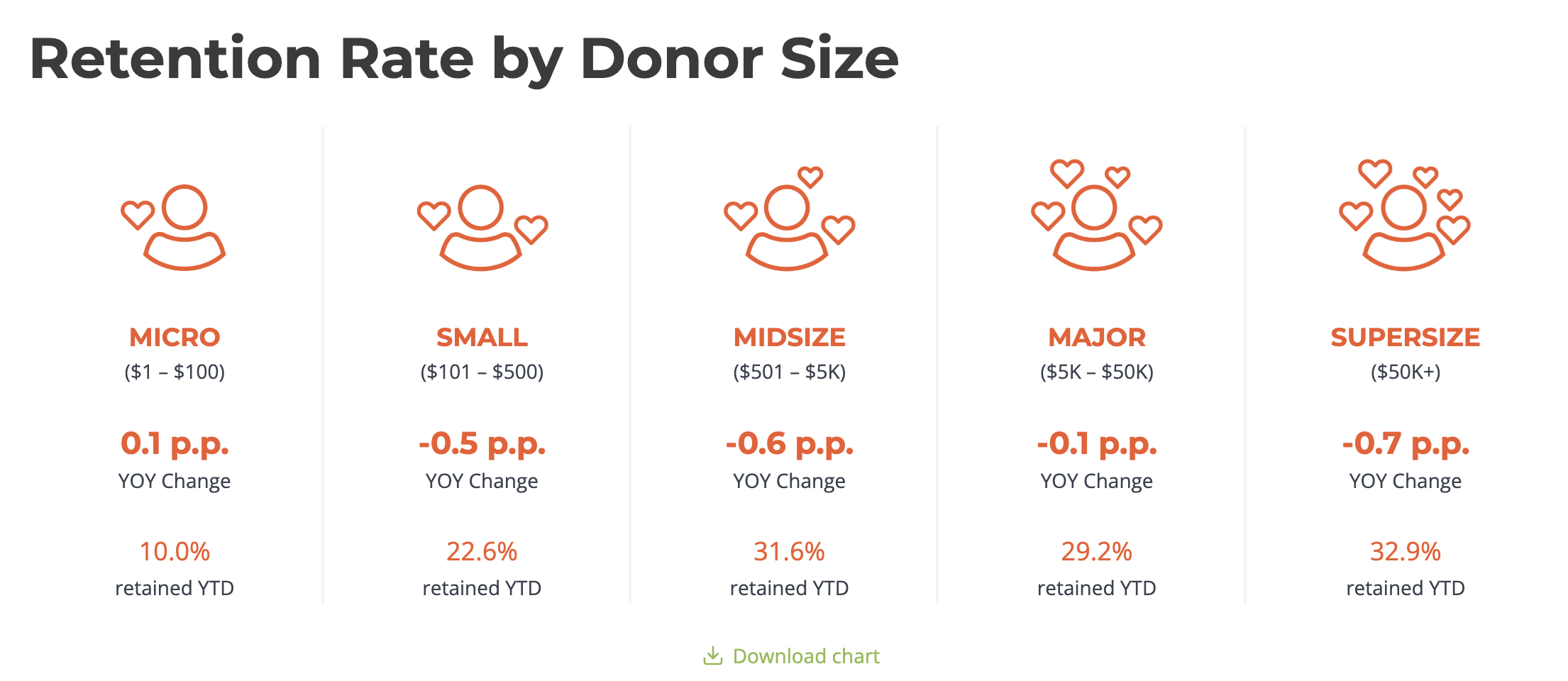
Credit: The Fundraising Effectiveness Project
Step Six:
Determine your numbers.
Put it all together: $1,353 + $55,246 = $56,599.40.
THAT is the number you can expect from previous Q4 donors if you didn’t recruit a single new donor this year.
If your organization hasn’t been list building or prospecting all year long — this amount should be where your financial goal centers around plus or minus 10% in both directions.
If you have been list building and prospecting — you can be more ambitious.
What’s Your End-of-Year Campaign Number?
Do the math and then let me know in the comments what your end-of-year fundraising goals are.
Cheering you on all the way past December 31.